
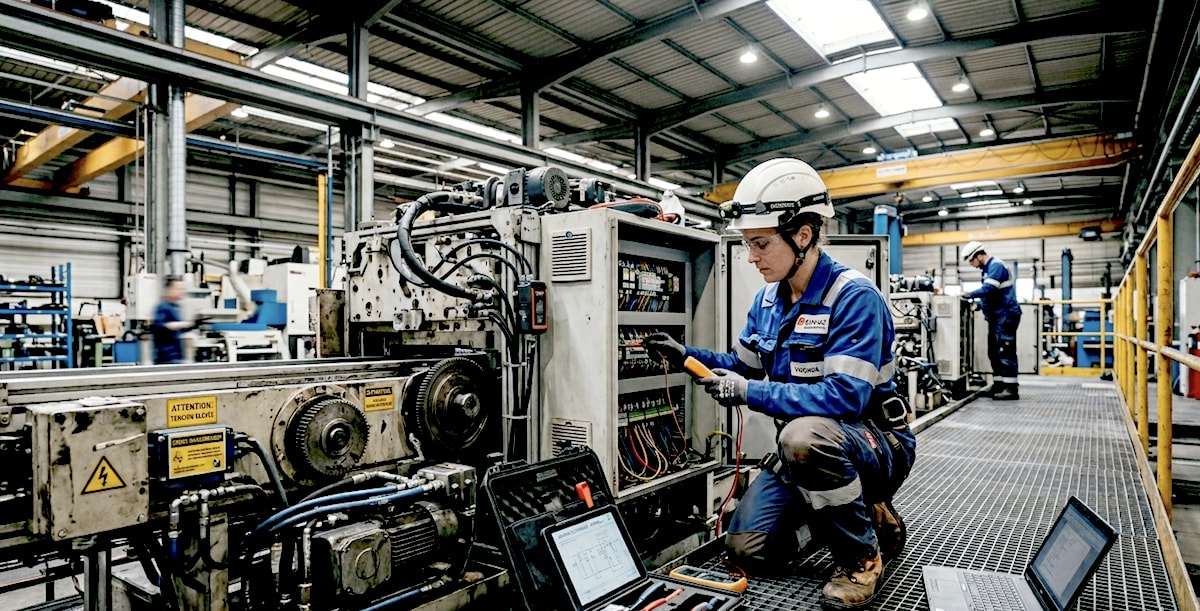
Why the most demanding teams choose Yuman for their major projects
Monday 06 april 2026
A maintenance manager on an industrial site is never idle. Between unplanned shutdowns costing tens of thousands of euros per hour, unmissable regulatory inspections, spare parts stocks that can't be found at the wrong time, and technicians juggling emergency and preventive maintenance, the pressure is constant. In this context, the choice of CMMS software is not a detail. It's a strategic decision.
But here's the problem: for a long time, the CMMS market for industry was dominated by behemoths - IBM Maximo, SAP PM, Infor EAM - powerful tools indeed, but cumbersome to implement, costly to maintain, and often shunned by technicians in the field for lack of ergonomics.
Yuman was born to change that. An enterprise-grade CMMS, designed from day one to be adopted - really adopted - by teams. In this article, we take a comprehensive look at what a high-level industrial CMMS should cover, and how Yuman meets these requirements point by point.
1. Technical assets at the heart of the system
It all starts with knowing your assets. On an industrial site, we're often talking about hundreds, sometimes thousands, of pieces of equipment - production lines, utilities, lifting equipment, fluid networks, electrical equipment. Without a reliable database, the rest doesn't add up.
A serious industrial CMMS must offer a clear hierarchical tree structure: Site → Zone → Line → Machine → Sub-assembly → Component. Each piece of equipment must carry a complete record - serial number, manufacturer, commissioning date, replacement value, location - and the full history of all interventions carried out since it was commissioned.
This repository is the site's technical memory. It enables the actual depreciation of an asset to be calculated, end-of-life equipment to be identified, and replacement investments to be prioritized on the basis of objective data rather than intuition.
Yuman centralizes all these technical assets in a clear interface, accessible from any workstation or directly from the field via the mobile application. The software knows each piece of equipment, its technical data sheet, usage schedule and preventive maintenance schedule, as well as its location, accessibility conditions and responsible contact persons. Yuman
2. The four faces of industrial maintenance
It's common to speak of "maintenance" as a homogeneous block. In reality, an industrial maintenance department simultaneously manages four quite distinct modes, each requiring different tools.
The four modes of maintenance
Systematic preventive maintenance
This is the foundation. Operating ranges planned at regular intervals - every X hours of operation, every Y months, every Z cycles. The stakes are twofold: don't forget anything, and don't needlessly consume resources on equipment that doesn't need them yet.
A good CMMS automatically generates preventive work orders, schedules them taking into account resource availability and production shutdown windows, and alerts on conflicts.
Conditional maintenance (CBM - Condition Based Maintenance)
The next step. Rather than maintaining at fixed intervals, we monitor the actual state of equipment'vibration, temperature, current, pressure'and intervene when measurements cross alert thresholds. The result: longer intervention intervals on equipment that is doing well, and anticipated failures on equipment that is deteriorating.
This requires the integration of IoT sensors, real-time monitoring dashboards, and automatic alert mechanisms triggering a request for intervention as soon as a threshold is crossed.
Predictive maintenance
The Holy Grail. By combining historical data and real-time measurements, machine learning algorithms estimate the remaining service life (RUL) of each piece of equipment and predict breakdowns before they occur. We move from a reactive to an anticipatory logic, with a massive impact on equipment availability and maintenance costs.
Corrective maintenance
Despite all the above, breakdowns remain unavoidable. When they do occur, every minute counts. CMMS must make it possible to create an intervention request in seconds, qualify it, assign it to the right available technician with the right skills, trace the diagnosis, root cause and remedy - and capitalize on this information to avoid recurrence.
Yuman natively covers these four modes, with curative and preventive maintenance planning and tracking, real-time information gathering and sharing, and collaboration between managers and technicians. Yuman
3. Inventory management: the sinews of war
There's nothing more frustrating for a technician than to have diagnosed a breakdown, have the OT in hand - and then have to wait three days because the part isn't in stock. Every hour of unplanned downtime on a production line quickly adds up to thousands of euros.
An advanced industrial CMMS must manage spare parts with a rigor comparable to that of a logistics warehouse:
- Automatic calculation of stock levels: minimum stock, safety stock, reorder point (ROP), economic order quantity (EOQ)
- Parts reservation on planned OTs: if a major overhaul is scheduled in six weeks, the necessary parts are reserved automatically
- Identification of critical parts: those with no known substitute, with a long supplier lead time, require special treatment
- Complete traceability: serial numbers, batch numbers, expiration dates, stock movements
- Automatic replenishment alerts before out-of-stock
Yuman natively integrates Yuman spare parts and inventory management, linked directly to work orders and purchase requisitions, to ensure that the right parts are in the right place at the right time.
4. Safety and regulatory compliance: zero tolerance
On an industrial site, maintenance isn't just about performance. It's also a matter of life and death. Accidents linked to poorly managed maintenance operations - absence of consignment, incomplete work permit, expired clearance - are among the most serious workplace accidents.
The Fantastic Four of Safety
The Permit to Work (PTW)
No work on live equipment, in confined spaces, at heights or with open fire should be launched without a formalized permit to work. This permit commits several players - issuer, performer, HSE signatory - and traces the validation of each safety step.
Lockout/Tagout (LOTO)
Lockout/Tagout is the procedure that guarantees that equipment is de-energized before any intervention. An advanced CMMS integrates this procedure into the OT workflow, with full traceability.
Habilitations and certifications
A technician cannot work on electrical equipment without valid authorization. The same applies to confined spaces, working at height, pressurized equipment and ATEX atmospheres. The CMMS must manage the expiry dates of all these certifications and block the assignment of an unauthorized technician to an OT that requires it.
Regulated equipment
Pressure vessels, lifting equipment, tanks, electrical installations - these are all subject to mandatory Periodic General Inspections (VGP). Missing them exposes the company to penalties, but above all to serious risks. The CMMS must alert before each due date, manage reports from inspection bodies, and archive these documents in a regulatory manner.
5. Field mobility: the adoption that does it all
This is often where CMMS projects fail. The software is deployed, the training is done - and six months later, technicians have gone back to their paper notebooks because the mobile application is too slow, too complex, or unusable without a connection.
An industrial CMMS must offer an impeccable mobile experience:
- Offline mode: in certain areas of an industrial site (electrical rooms, basements, ATEX zones), network coverage is non-existent. The application must operate without a connection and synchronize as soon as the network returns
- QR Code / NFC scanning to instantly identify equipment and access its file, history and range
- Access to drawings, diagrams and manuals directly from the field
- Entering the intervention report with photos and videos
- Electronic signature of the equipment's status
- Electronic signature of the equipment's status
- Electronic signature of the equipment's status
- Interface designed for hands that have worked - not for consultants in open spaces
Yuman has been designed for mobility, operating on 3G/4G networks as well as off-network, for its web interface, for ease of start-up and use, and for the completeness of its intervention and maintenance management functionalities. Yuman
6. KPIs that make the difference
You can't improve what you don't measure. An industrial maintenance manager must pilot his department with precise indicators, in real time, not with Excel exports compiled manually every month.
The essential KPIs of mature industrial maintenance:
MTBF (Mean Time Between Failures) - the average time between two equipment breakdowns. A decreasing MTBF is an early warning signal about the condition of the equipment.
MTTR (Mean Time To Repair) - the mean time to repair. It measures the efficiency of the maintenance department: availability of parts, skills of technicians, clarity of ranges.
TRS / OEE (Overall Equipment Effectiveness) - the industry's king indicator. It combines availability, performance and quality to give an overall index of a production line's efficiency. An SRR of 85% is considered a "world class" level.
Preventive / corrective ratio - target: more than 70% of maintenance time devoted to preventive. A lower ratio means that the team is chasing breakdowns rather than anticipating them.
Maintenance backlog - the volume of OTs in the queue. An accumulating backlog is a sign that resources are insufficient or poorly planned.
Maintenance cost to replacement value (%RAV) - an indicator for inter-site and inter-sector benchmarking.
Yuman offers automatically generated KPIs to best optimize a company's activity, Appvizer with role-configurable dashboards - what a technician sees is not what a site manager sees, which is not what senior management sees.
7. Integration into the plant's digital ecosystem
A CMMS is not an island. On a modern industrial site, it must be integrated with the entire information system:
- ERP (SAP, Oracle, Sage) for asset accounting, inventory valuation, purchasing flows
- SCADA / DCS for automatic feedback of alarms and equipment counters
- ;equipment
- MES to retrieve production data and calculate OEE in real time
- IoT / IIoT to integrate condition monitoring sensors (OPC-UA, MQTT, Modbus)
- GED for centralized document management (isometric drawings, P&ID, notices, procedures)
Yuman is a unique CMMS solution for both industry and maintenance service providers, integrating production equipment found in industry as well as infrastructure equipment. Yuman
8. What really sets Yuman apart in the industrial market
CMMS have been around since the 1980s. So why does Yuman stand out on demanding industrial sites, against incumbents with decades of development behind them?
Because functional power is useless without adoption.
IBM Maximo can do it all. So can SAP PM. But implementing these solutions takes 12 to 24 months, mobilizes expensive integrators, and often results in a tool so complex that only a few key users actually know how to use it. As a result, technicians bypass the system, data is incomplete, and the promise of CMMS is never kept.
Yuman's main appeal lies in its ease of use. Thanks to an optimized user experience and easy data retrieval, the software is quick to get to grips with. Yuman is also designed to streamline monitoring and communication, with a shared schedule showing technicians'actions in real time. Appvizer
This isn't a compromise on functionality - it's a design choice. Yuman doesn't sacrifice power for simplicity. It does both.
Yuman reinvents what a mobile CMMS should be, with the ambition of offering the best tool available on the market. Yuman enables your managers to communicate instantly with their technicians in the field, to better deal with urgent problems, resolve complex cases, collect information and share it directly. Logiciels.Pro
Conclusion: industrial CMMS is no longer reserved for large groups
For a long time, deploying a truly comprehensive CMMS on an industrial site was the prerogative of large companies - the only ones able to finance licenses, integrators, and years of deployment.
Those days are gone.
Yuman brings to the industrial market what the best SaaS solutions have brought to other sectors: exhaustive functional coverage, a modern user experience, rapid deployment, and an affordable business model - without compromising on robustness.
Whether you run a site with 20 technicians or a multi-line plant with hundreds of regulated pieces of equipment, Yuman adapts to your level of maturity and accompanies your ramp-up.
Maintenance is not a cost center. It's a competitive lever. Companies that have understood this have long since put their CMMS at the heart of their industrial strategy.
Would you like to see Yuman in action on a real-life industrial site? Request a personalized demonstration →
Back to the articles